Immanuel: Is God with us?
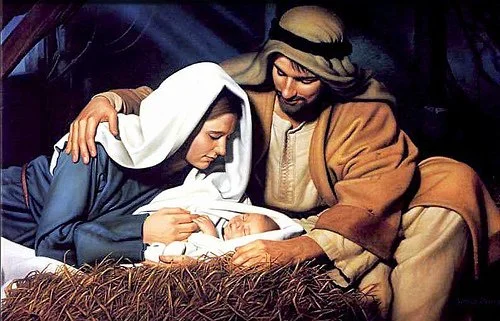
"Behold, the virgin shall conceive and bear a son, and shall call his name Immanuel" (Isaiah 7:17).
Without Christ, it is always winter, but never Christmas (CS Lewis). Once in our world, a stable in Bethlehem held something bigger than our whole world—Immanuel, “God with us.” The Christmas icon, preserved by the Orthodox church, offers an unusual depiction of the manger scene; the donkey and ox stand nearest Christ. This ancient tradition is based on Isaiah’s prophecy proclaiming they [donkey and ox] knew their master and creator, but Israel did not know him (Isaiah 1:3,4) The lowly animals understood more of the first Christmas than all the high priests in Jerusalem. The promised Christ had come, the fulfillment of all their ritual sacrifices, and they failed to welcome him. Herod the Great missed him too. The paranoid King of Judea, intent on killing Messiah, responded with the Massacre of the Innocents. Were it not for the shepherds, there would have been no reception. And were it not for a group of stargazers, there would have been no gifts (Christmas story here). One silent night, the veil was pierced, and God entered time for all eternity.
Some children see Him lily white
The baby Jesus born this night
Some children see Him lily white
With tresses soft and fair
Some children see Him bronzed and brown
The Lord of Heaven to earth come down
Some children see Him bronzed and brown
With dark and heavy hair… (Some Children See Him, James Taylor https://genius.com/James-taylor-some-children-see-him-lyrics ).
Context: What did the original audience know and understand?
God distanced himself not long after the flood, and wickedness settled down for a long stay. The ancient gods of chaos no longer masked their distain for humanity by patronizing them with forbidden wisdom. Instead the gods were bent on destroying the crown of God’s creation by enticing humans to do unimaginable acts of evil. At the base of the Tower of Babel, God dispersed the nations by confusing their language, and the gods of chaos were banished to the underworld. Discover more about the Tower of Babel and why God distanced himself (here). Out of the rubble God created a nation for himself, Israel, and dispatched her to be his witness to the nations. But she failed in her mission, doing unimaginable acts of evil, including the slaughter of innocent children. Like debris carried on the wind, God scattered her to the ends of the earth. From the beginning, Moses warned Israel that covenant breakers would be cut off and replaced by a people who were “not a nation” (Deuteronomy 32:21). The prophet Hosea foretold that those once called “my people” will be called “not my people”, while those who were not God’s people will become sons of the living God (Hosea 2:23). Isaiah said that those who did not seek him, namely the nations, will find him (Isaiah 65:1-2). Haggai and Malachi said the glory of the second temple will be greater than the first (Haggai 2:6-9), and God himself will come to that temple (Malachi 3:1). In short, the Old Covenant pointed toward a New Covenant. Just as God disrupted the language at Babel, he would disrupt the Old Covenant in the tribal language of Israel (Hebrew), and inaugurate his New Covenant in the universal language of the nations (Greek). In other words, the fragmentation of language at Babel would be reunited at Pentecost. God, who distanced himself, would draw near once again— Immanuel.
Historical and Theological Progression: In the ancient world gods were thought to be territorial, limited in their sphere of influence, so cities were constructed around temples and shrines dedicated to the unique god of the region. Thus the command to build cities without shrines and temples in ancient Israel represented a point of tension, making the Israelites prone to syncretism and idolatry. Culturally, they couldn’t understand the construction of such a city. The woman at the well in Samaria is perplexed for the same reason, asking, “Where shall we worship?” (John 4:1-42). To which Jesus responds, “A time is coming when you’ll neither worship on this mountain nor in Jerusalem. God is spirit, therefore his worshipers must worship in the Spirit and in truth.” God’s temple exists wherever believers dwell because God’s spirit resides in each one of them. There is no need for the Jerusalem-centered sacrificial system to continue when the Christ-centered, once-for-all sacrifice, has been made (Hebrews 10:1-18). The old operating system of retribution and collective punishment, “an eye for an eye” is null and void (Hebrews 8:13); Jesus’ new operating system of grace and eternal forgiveness, “do unto others as you would have them do unto you” is living and active (Luke 6:31). Which operating system do you live by? What does “God with us” really mean? George MacDonald, friend of CS Lewis, penned this parable, creatively describing the process of transformation. Imagine yourself as a living house. God comes in to rebuild that house. At first, perhaps, you can understand what he is doing. He is getting the drains right and stopping the leaks in the roof and so on: you knew that those jobs needed doing and so you are not surprised. But presently he starts knocking the house about in a way that hurts abominably and does not seem to make sense. What on earth is he up to? The explanation is that he is building quite a different house from the one you thought of— throwing out a new wing here, putting on an extra floor there, running up towers, making courtyards. You thought you were going to be made into a decent little cottage: but he is building a palace. He intends to come and live in it himself. If we let him, he will make the feeblest and filthiest of us into a god or goddess, a dazzling, radiant, immortal creature, pulsating all through with such energy and joy and wisdom and love as we cannot now imagine, a bright stainless mirror which reflects back to God perfectly his own boundless power and delight and goodness. The process will be long and in parts very painful; but that is what we are in for (CS Lewis). Christ in us, our hope in glory… changing us from glory to glory (2 Corinthians 3:18) That is what is meant by “God with us.” Nothing less.
Conclusion: All too often we are audacious creatures who lack understanding. In truth, there has been only one Christmas—the rest are anniversaries of God’s amazing grace. Today in Bethlehem, at the Christmas Lutheran Church, the Christ child lies among the rubble, reminding us that God chose not safety, not power, not palaces—but vulnerability and solidarity with the crushed of the earth. It is a declaration of hope where despair is expected to rule, a poignant picture of the persecuted Palestinian church and the ongoing slaughter of the innocent (X@MuntherIsaac). Across the spiritual divide efforts are underway, by Jewish and Christian Zionists alike, to erect a third temple in Jerusalem, to resume ritual sacrifices rooted in the Old Covenant. To whom will they sacrifice? Israel rejected Christ, therefore she is antichrist. God will not be there. He already left the building (Matt 23:38). Two-thousand years ago the veil was torn in two, and the temple was destroyed because Israel would not believe. While the world rejoices anew, celebrating the Christ of Christmastime, Jerusalem fails to welcome him, once again distancing themselves from the One who changed the course of every silent night to come. Scripture makes clear, God’s divine, eternal dwelling is a temple made without human hands (Acts 17:24), within every human heart that believes. Jesus is, and will always be—Immanuel.
The children in each different place
Will see the baby Jesus' face
Like theirs, but bright with heavenly grace
And filled with holy light
O lay aside each earthly thing
And with thy heart as offering
Come worship now the infant King
'Tis love that's born tonight. (Some Children See Him by Kenny Loggins, https://www.youtube.com/watch?v=8X0S6RkRGqw)
Sources: Jesus Through Middle Eastern Eyes, Kenneth Bailey; The Baal Book, Stephen de Young; Mere Christianity, CS Lewis; The Case for the Real Jesus, Lee Strobel