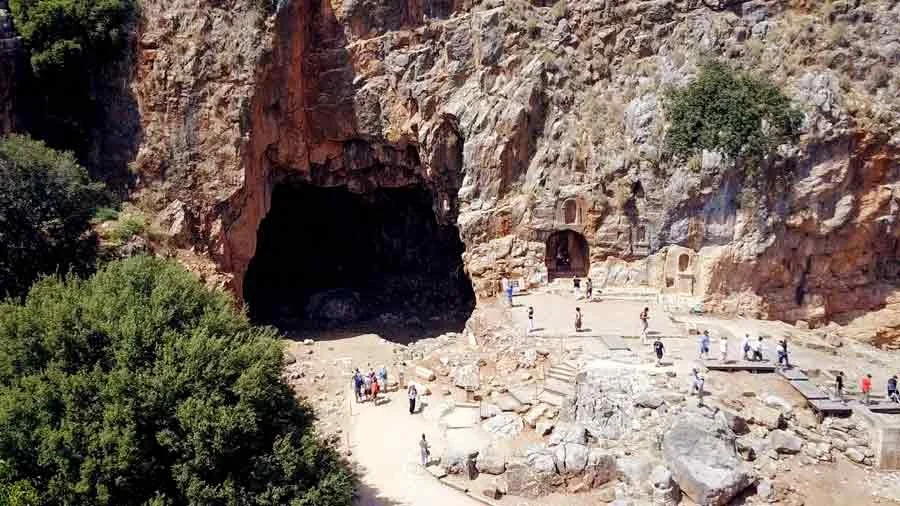
Upon this rock I will build my church, and the Gates of Hades shall not be able to stand against her.
(Matthew 16:18).
A Chinese philosopher insisted on riding his mule backwards so that he would not be distracted by where he was going and could instead reflect on where he had been. The Bible works in somewhat the same way. The New Testament sheds light backward on the Old Testament, which is the Bible Jesus read and used. The places Jesus goes and what he says have a very deep history in the Old Testament. There is an element of spiritual, geographical dominion woven throughout that indicates messiah must conquer the demonic realm on their own turf. CS Lewis famously describes the story of Jesus as “the true myth.” Hidden in the promise of messiah is the painful, heartrending, hope-giving seeds of upheaval, controversy, and metamorphosis: whispers and rumors of a coming change that promises to turn the whole world on its ear. His vision of a kingdom is so outlandishly marvelous and crazy, so radically different from anything we could ever have conceived or invented in our own power, that it’s nearly impossible to wrap the human mind around it. None of the dark, spiritual rulers of the age understood it either, because messianic prophecy in the Old Testament is deliberately cryptic. If they had known, they would not have crucified the Lord of glory (1 Corinthians 2:6-8). Jesus is the provenance of every fairy tale, the prince who slays the dragon, the hero of every human heart. Fairy tales do not tell children that monsters exist. Children already know that monsters exist. Fairy tales tell children that monsters can be killed (GK Chesterton).
Context: What did the original audience know and understand?
The Bible is always grounded in dirt. Location. Location. Location. The location of events is significant. The Old Testament describes a world where cosmic-geographical lines have been drawn. Israel was on holy ground because it was God’s (Yahweh’s) inheritance (Deuteronomy 32:8-9); the territory of other nations belonged to other gods (elohim). In short, ancient people believed the gods were limited to specific locations. Case in point: Naaman asks for dirt. According to 2Kings 5, Naaman, commander of the Aramean (Syrian) army, decides to seek the prophet Elisha for a cure for his condition. He travels to Israel, but Elisha doesn’t even come out to talk to him in person. He sends a messenger to tell the military hero to wash himself in the Jordan seven times if he wants to be healed. Insulted, Naaman at first resists, then relents at the encouragement of his servants. He does as instructed, and emerges cleansed from the skin disease. Naaman returns to the prophet and affirms “there is no God in all of the world except in Israel.” He vows he will sacrifice only to Yahweh. But how can he keep that vow after departing Israel and returning to Syria? Simple—he asks for dirt to take home. He takes as much dirt as his mules can carry so he can worship Yahweh on Yahweh’s own territory, even though Naaman lives in the domain of the god Rimmon.
Historical and Theological Progression:
Dirt is at the forefront of the Jewish mind in the first century. They are awaiting the coming of the promised messiah, a strong man who will restore their land and their kingdom, by overthrowing the Romans. In the province of Judea, a man appears claiming to be a teacher from God. Many Jews leave their homes and jobs and follow him, believing he is the Messiah, their long-awaited, miracle-working leader. But he is executed by the Romans and his followers disperse. The name of this failed prophet was Theudas. He was not the only alleged messiah in this period; in fact, there were quite a few. They all caused a local stir, and almost all met grisly ends. You, of course, are aware of another—Jesus. During his earthly ministry he performed many miracles: healing the sick, raising the dead, and casting out demons. The demons knew exactly who he was. The different titles they used for Jesus reveal a profound boundary regarding territorial authority in the ancient spiritual realm. Modern readers bifurcate reality as sacred or secular, when, in fact, it is all sacred space that belongs to the Creator. There is no neutral ground in the universe. Every square inch, every split second is claimed by God and counterclaimed by satan (CS Lewis). In Judea (Israel's territory) the demons typically addressed or acknowledged Jesus through messianic and royal titles, such as “Son of David.” They knew Jesus was the legitimate Jewish King stepping onto His home turf. On Gentile land, outside Israel’s territory, the demons addressed Jesus as the “Son of the Most High God.” They recognized that they were standing before the supreme sovereign who holds ultimate authority over the entire cosmic hierarchy, not just the borders of Israel. Dirt makes a difference; Jesus had come to reclaim every inch of it from the demonic squatters.
What is the rock? Jesus makes his fiery statement about the Gates of Hades at a specific location (pictured above), and Matthew marks the spot—ground zero in the cosmic-geography of both the Old and New Testaments. Matthew begins his narrative with this statement: “When Jesus came to the region of Caesarea Philippi.” It is a place filled with Old Testament history that saw many conquest battles against demonic tribes, when Israel first entered the promised land. It was known as Bashan, meaning “serpent,” or “the place of the serpent.” After his rebellion in Eden, the divine serpent became lord of the dead, when he was cast down to the underworld. Bashan is the location of the gates of hell (Greek: Gates of Hades), and the place of worship to Baal, Lord of the Dead. This is where Jesus asks the famous question, “Who do people say that I am?” Peter, always impetuous, declares, “You are the Christ, the Son of the living God.” Jesus replies, telling Peter his testimony is not outstanding. Peter only knows what he knows because the Father told him. Furthermore, his name, Peter, signifies he is merely a small stone (petros). In contrast, Jesus declares “upon this large stone (petra) I will build my church,” on the immovable slab of bedrock beneath their feet, at the gateway to the underworld. Some things remain hidden until they reveal themselves in the simplest ways. For instance, it’s difficult to find black socks in a dark room, unless they smell. Locating Jesus at the threshold of hell unearths the foundation of the church, and the stench of the demonic realm she is equipped to conquer. Bedrock is what Jesus has in view, not Peter.
Where are the Gates of Hades? The ancient Mesopotamians shared a common perception of the underworld, that was an inversion of Eden, the mountain of God. The ruler of the underworld was the god, Baal. In a cosmic-geographical sense, it is the columns of Baal’s kingdom, beneath the ground, that hold up the earth. Ezekiel and Isaiah ridicule this god, equating him to the devil of the Old Testament. The most prominent feature of Baal’s palace is its brazen gates—gates of brass. Why brass? The context is connected to the Bronze Age (3300-1200 BC). You may recall Babel was the epicenter of bronze smelting (here), a strong metal excellent for making weapons and amour. Bronze was the tip-top technology of its time, so one would expect the gates of the underworld to be strong, made of bronze. Instead they are made of brass, a cheep imitation. Brass was the pleather of the bronze age. Flashy, ostentatious like crinkum-crankum, but worthless as a strong defense. By describing the Gates of Hades as brass, Scripture is mocking them as flashy junk, and the secret knowledge that inspired them is worthless. At the threshold of hell, Jesus is putting the devil on notice: the gates are under assault, and they will not hold up against the power of the church. Hell will one day be the devil’s tomb.
What is Mount Hermon? The chain of events that follow the incident at the Gates of Hades reveal Jesus’ objective. He is intentionally baiting the enemy; the location is deliberate. The text says the transfiguration (Matthew 17:1-6) takes place on a high mountain, Mount Hermon (here), known throughout history to be the place where the council of the gods dwelt. For Jewish readers, the name “Hermon” (khermon) has the same root as a verb that is of central importance in the conquest narratives: kharam, “to devote to destruction.” This is the distinct verb of holy war, the verb of extermination. The imagery is striking. On the mount of extermination Jesus throws down the gauntlet, claiming ground for the Kingdom of God, revealing himself to Peter, James, and John. His disciples see him exactly as he is—the embodied glory-essence of God, the divine Word made visible by incarnation. The demons see him, too. They know who Jesus is, but they do not know the plan. At the very place where the sons of God gave birth to the demonic realm (here) (Genesis 6:1-4), the Son of God is putting their progeny on notice. Jesus baits them into action, and act they will. Little do they know, their instrument of death will be the catalyst that launches the kingdom of God in its full force, reversing the human predicament and ensuring the defeat of the powers of darkness. Jesus, alone, holds the key. Upon his death, he descends into the realm of the dead, sets the captives free, and rises from the grave, victorious (1Peter 3:18-20). If the demons had only known, they would not have crucified the Lord of glory. Maybe they missed the thrust of Jesus warning, “Do not fear those who kill the body but cannot kill the soul. Rather fear him [God] who can destroy both soul and body in hell” (Matthew 10:28). Judgment is coming (2Peter 2:4). Monsters can be killed.
Jesus carefully delineated the makeup of the church: He is the cornerstone and believers are the living stones of the house of God. During the early centuries following Jesus’ ascension, the church was right where she was supposed to be—at the threshold of hell—like a Greek phalanx of soldiers, shields locked together, strategically positioned as a bulwark against evil. The Sermon on the Mount was the rubric, the gifts of Pentecost were alive and active, and the demonic realm was defined and deterred with the full amour of God (here). The Book of Acts depicts a unified church, caring for widows and orphans (James 1:27), carrying the Gospel to the ends of the earth. The tradition identifying Peter as the first bishop of Rome did not exist until Irenaeus (late 2nd century), and Eusebius (early 4th century), which eventually lead to the hierarchical organization of the church (here), apostolic succession, designation of a pope, and the fracturing of the church.
Conclusion: One sees great things from the valley; only small things from the peak (Gilbert K. Chesterton). The transfiguration of Christ highlights Peter’s awe and misunderstanding of Jesus’ mission. Enraptured by a glory he’s never seen, he declares, “Lord, it is good for us to be here.” In that moment, he desires above all else to remain on the mountain top, to build a physical structure to capture God’s holy presence, to prolong the visible glory, rather than descend back toward suffering and the cross. The church made visible on Mount Hermon is the same church established on the bedrock before the Gates of Hades. She is equipped to span the distance between heaven and hell, to extend the Kingdom of God, and to reclaim creation for Christ. For two-thousand years she has toiled, with varying degrees of success, to complete the task before her. Lately, the whispers and rumors of a coming change that promises to turn the whole world upside down, are getting louder. The marvelous and outlandish vision of the kingdom is becoming clearer. May the church persevere, keep her eyes fixed on Jesus, and remain faithful to the end.
The Prayer of St. Francis
Lord make me an instrument of your peace,
Where there is hatred let me sow love.
Where there is injury, pardon.
Where there is doubt, faith.
Where there is despair, hope.
Where there is darkness, light.
And where there is sadness, joy.
O divine master grant that I may
not so much seek to be consoled as to console;
to be understood as to understand;
To be loved as to love
For it is in giving that we receive-
it is in pardoning that we are pardoned.
And it’s in dying that we are born to eternal life.
Amen (Performed by Sarah Mclachlan here).
Sources: The Unseen Realm, Michael Heiser; Jesus at the Gates of Hell, https://www.youtube.com/watch?v=foymFXr1mlE, Michael Heiser; Tabor and Hermon, https://blogs.ancientfaith.com/wholecounsel/2019/08/05/tabor-and-hermon/, Stephen de Young; Babel, Bashan, and the Gates of Hell, https://www.youtube.com/watch?v=7fjpVavh1bk&list=PLG8F8siSimu4&index=9&t=1383s, Michael Heiser; Caesarea Philippi and the Nephilim?https://www.biblestudywithrandy.com/2016/03/caesarea-philippi-nephilim/, Randy McCracken; God of the Fairy Tale, Jim Ware; The Gospel and Spade—Basham, https://www.youtube.com/watch?v=cQQeF9JkmxU; Reversing Hermon, Michael Heiser; The Baal Book, Stephen de Young; A Short History of Christianity, Stephen Tomkins;